Analysis of combinatorial effect using bayesynergy method
Junyan Lu
2022-04-25
Last updated: 2022-05-20
Checks: 5 1
Knit directory: combiDLBCL/analysis/
This reproducible R Markdown analysis was created with workflowr (version 1.7.0). The Checks tab describes the reproducibility checks that were applied when the results were created. The Past versions tab lists the development history.
Great job! The global environment was empty. Objects defined in the global environment can affect the analysis in your R Markdown file in unknown ways. For reproduciblity it’s best to always run the code in an empty environment.
The command set.seed(20220425) was run prior to running
the code in the R Markdown file. Setting a seed ensures that any results
that rely on randomness, e.g. subsampling or permutations, are
reproducible.
Great job! Recording the operating system, R version, and package versions is critical for reproducibility.
Nice! There were no cached chunks for this analysis, so you can be confident that you successfully produced the results during this run.
Great job! Using relative paths to the files within your workflowr project makes it easier to run your code on other machines.
Tracking code development and connecting the code version to the
results is critical for reproducibility. To start using Git, open the
Terminal and type git init in your project directory.
This project is not being versioned with Git. To obtain the full
reproducibility benefits of using workflowr, please see
?wflow_start.
Load libraries and datasets
Preprocess
Only use CHP_Pola plates
screenSub <- filter(screenData, Drug_B == "CHP_Pola")Create input
allPair <- distinct(screenSub, Name, Drug_A) %>%
  filter(Drug_A != "DMSO")
allInput <- lapply(seq(nrow(allPair)), function(i) {
  n <- allPair[i,]$Name
  m <- allPair[i,]$Drug_A
  viabTab <- filter(screenSub, Name == n) %>%
    select(Drug_A, Drug_B, Drug_A.Conc, Drug_B.Conc, normVal)
  bTab <- filter(viabTab, Drug_A == "DMSO")
  aTab <- filter(viabTab, Drug_A == m)
  testViab <- bind_rows(aTab, bTab)
  y <- as.matrix(data.frame(viability=testViab$normVal))
  x = as.matrix(testViab[,c("Drug_A.Conc","Drug_B.Conc")])
  list(y=y, x=x, drug_names = c(m,n), experiment_ID = paste0(n,"_",m))
})
Fit bayesynergy model
fit <- synergyscreen(allInput, save_raw = F, save_plots = F, bayesynergy_params = list(method = "vb"))
save(fit, file = "../output/fit.RData")
Load previous results (fitting takes long time)
load("../output/fit.RData")Get the result table
allRes <- fit$screenSummary
ciTabBayes <- tibble(Name = allRes$`Drug B`,
                 Drug_A = allRes$`Drug A`,
                 syn = allRes$`Synergy (mean)`,
                 anta = allRes$`Antagonism (mean)`
                 #syn = allRes$`Synergy Score`,
                 #anta = allRes$`Antagonism Score`
                 )
Visualization of synergistic and antagoistic effect
Scatter plot
plotSynScatter(ciTabBayes, 0.05)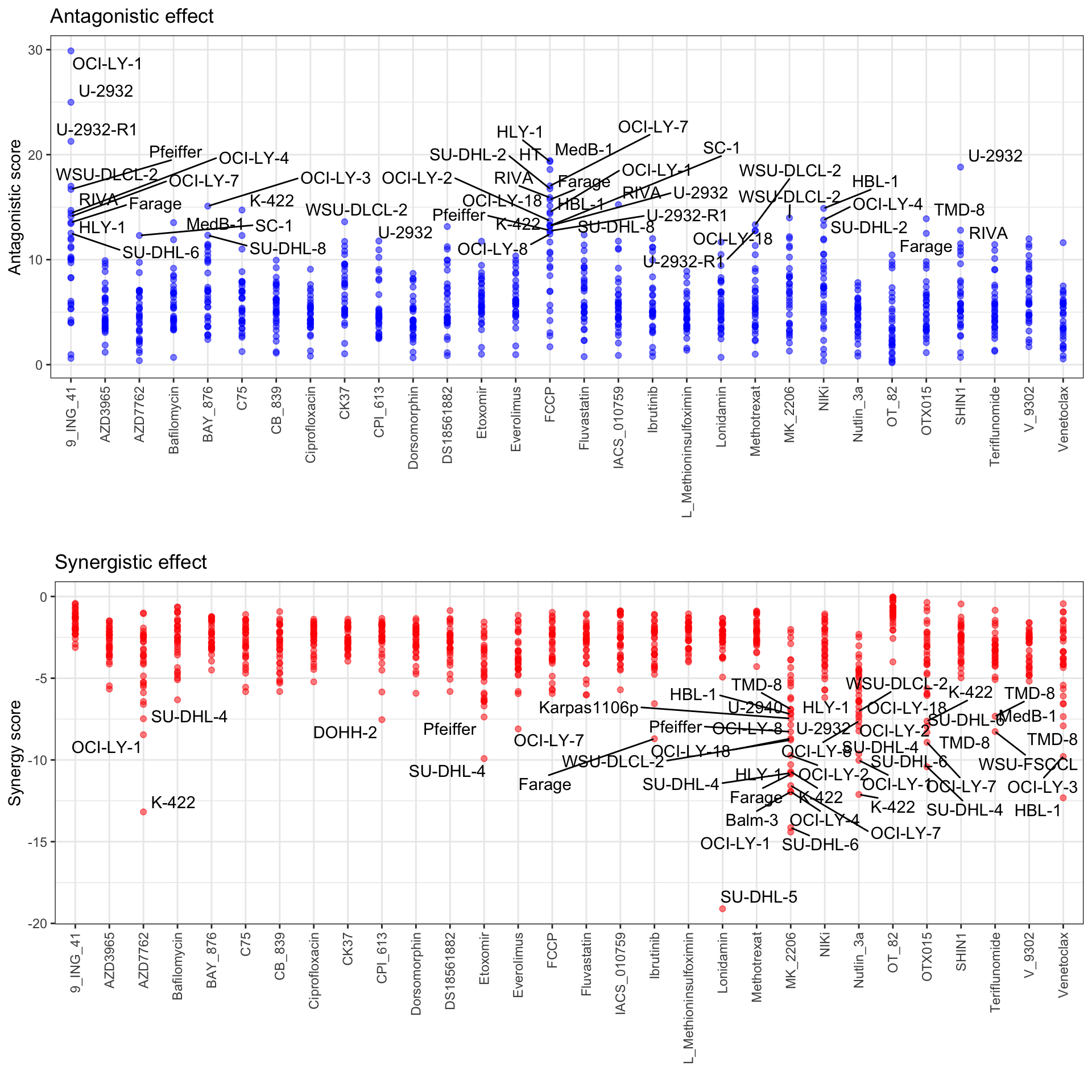
Matrix visualization
plotSynMatrix(ciTabBayes, 0.1, 0.2)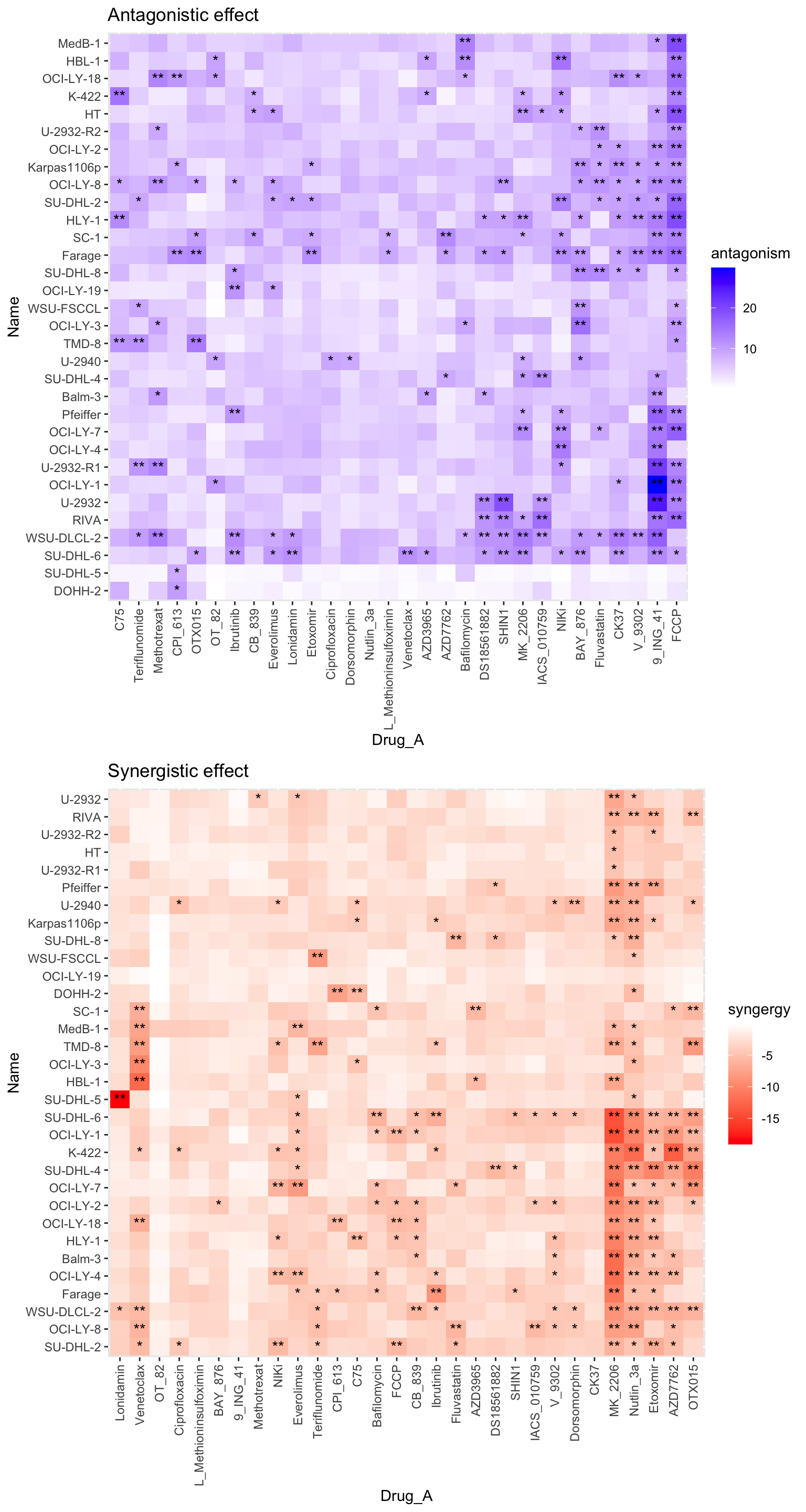
Correlate summarised CI to the single angent response of CHP_Pola
Add single agent CHP_Pola or CHOP response
polaTab <- screenData %>% filter(Drug_A == "DMSO", Drug_B == "CHP_Pola",!ifEdge) %>%
  group_by(Name) %>% summarise(viabPola = mean(normVal))
Test for correlation
testTab <- left_join(ciTabBayes, polaTab, by = "Name") %>%
  pivot_longer(c("viabPola"), names_to = "Drug_B", values_to = "viab") %>%
  pivot_longer(c("syn","anta"), names_to = "effect", values_to = "score")

resTab <- group_by(testTab, Drug_A, Drug_B, effect) %>% nest() %>%
  mutate(m=map(data, ~cor.test(~score+viab,.))) %>%
  mutate(res = map(m, broom::tidy)) %>%
  unnest(res) %>%
  select(Drug_A, Drug_B, estimate, p.value, effect) %>%
  ungroup() %>% group_by(effect) %>%
  mutate(p.adj = p.adjust(p.value, method = "BH")) %>%
  arrange(p.value)
Correlation with synergistic
resTab.syn <- filter(resTab, p.adj <0.1, effect == "syn")
pList <- lapply(seq(nrow(resTab.syn)), function(i) {
  rec <- resTab.syn[i,]
  plotTab <- filter(testTab, Drug_A == rec$Drug_A, Drug_B==rec$Drug_B, effect == rec$effect)
  ggplot(plotTab, aes(x=viab, y=score, label = Name)) +
    geom_point(aes(col=Name)) +
    geom_smooth(method = "lm",se=FALSE) +
    ggrepel::geom_text_repel() +
    theme(legend.position = "none") +
    xlab(rec$Drug_B) + ylab("average CI") +
    ggtitle(sprintf("%s\n(p=%s, coef=%s)",rec$Drug_A, formatC(rec$p.value, digits = 2),formatC(rec$estimate, digits = 1)))
})
cowplot::plot_grid(plotlist=pList)
`geom_smooth()` using formula 'y ~ x'
`geom_smooth()` using formula 'y ~ x'
`geom_smooth()` using formula 'y ~ x'
`geom_smooth()` using formula 'y ~ x'
`geom_smooth()` using formula 'y ~ x'
`geom_smooth()` using formula 'y ~ x'
`geom_smooth()` using formula 'y ~ x'
`geom_smooth()` using formula 'y ~ x'Warning: ggrepel: 1 unlabeled data points (too many overlaps). Consider increasing max.overlaps
ggrepel: 1 unlabeled data points (too many overlaps). Consider increasing max.overlaps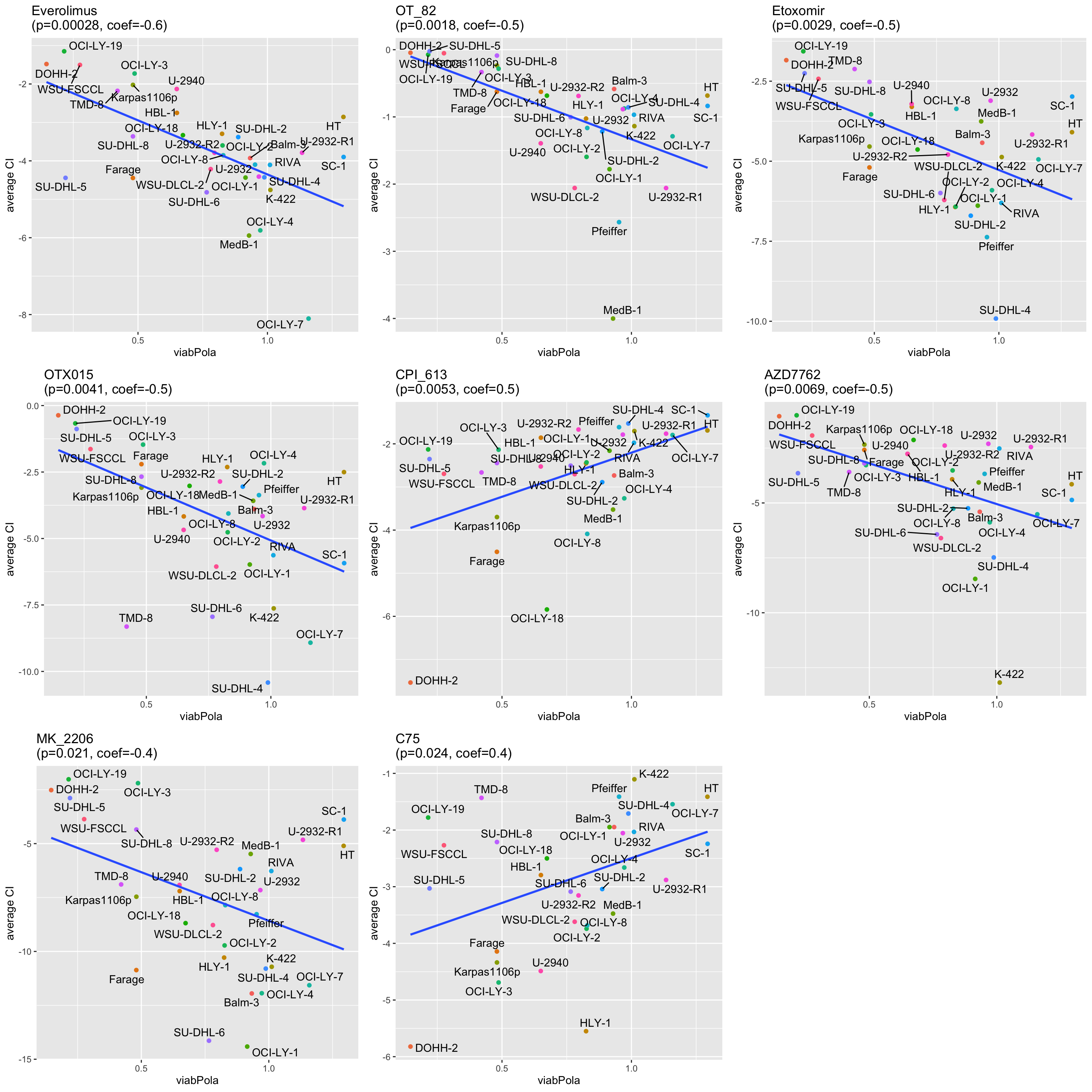
Correlation with antagonistic
resTab.anta <- filter(resTab, p.adj <0.1, effect == "anta")
pList <- lapply(seq(nrow(resTab.anta)), function(i) {
rec <- resTab.anta[i,]
plotTab <- filter(testTab, Drug_A == rec$Drug_A, Drug_B==rec$Drug_B, effect == rec$effect)
ggplot(plotTab, aes(x=viab, y=score, label = Name)) +
geom_point(aes(col=Name)) +
geom_smooth(method = "lm",se=FALSE) +
ggrepel::geom_text_repel() +
theme(legend.position = "none") +
xlab(rec$Drug_B) + ylab("average CI") +
ggtitle(sprintf("%s\n(p=%s, coef=%s)",rec$Drug_A, formatC(rec$p.value, digits = 2),formatC(rec$estimate, digits = 1)))
})
cowplot::plot_grid(plotlist=pList)`geom_smooth()` using formula 'y ~ x'
`geom_smooth()` using formula 'y ~ x'
`geom_smooth()` using formula 'y ~ x'
`geom_smooth()` using formula 'y ~ x'
`geom_smooth()` using formula 'y ~ x'
`geom_smooth()` using formula 'y ~ x'
`geom_smooth()` using formula 'y ~ x'
`geom_smooth()` using formula 'y ~ x'
`geom_smooth()` using formula 'y ~ x'
`geom_smooth()` using formula 'y ~ x'
`geom_smooth()` using formula 'y ~ x'
`geom_smooth()` using formula 'y ~ x'
`geom_smooth()` using formula 'y ~ x'
`geom_smooth()` using formula 'y ~ x'
`geom_smooth()` using formula 'y ~ x'Warning: ggrepel: 13 unlabeled data points (too many overlaps). Consider
increasing max.overlapsWarning: ggrepel: 16 unlabeled data points (too many overlaps). Consider
increasing max.overlapsWarning: ggrepel: 12 unlabeled data points (too many overlaps). Consider
increasing max.overlapsWarning: ggrepel: 13 unlabeled data points (too many overlaps). Consider
increasing max.overlapsWarning: ggrepel: 11 unlabeled data points (too many overlaps). Consider
increasing max.overlapsWarning: ggrepel: 8 unlabeled data points (too many overlaps). Consider
increasing max.overlapsWarning: ggrepel: 17 unlabeled data points (too many overlaps). Consider
increasing max.overlapsWarning: ggrepel: 15 unlabeled data points (too many overlaps). Consider increasing max.overlaps
ggrepel: 15 unlabeled data points (too many overlaps). Consider increasing max.overlapsWarning: ggrepel: 16 unlabeled data points (too many overlaps). Consider
increasing max.overlapsWarning: ggrepel: 13 unlabeled data points (too many overlaps). Consider
increasing max.overlapsWarning: ggrepel: 14 unlabeled data points (too many overlaps). Consider
increasing max.overlapsWarning: ggrepel: 11 unlabeled data points (too many overlaps). Consider
increasing max.overlapsWarning: ggrepel: 12 unlabeled data points (too many overlaps). Consider
increasing max.overlapsWarning: ggrepel: 8 unlabeled data points (too many overlaps). Consider
increasing max.overlaps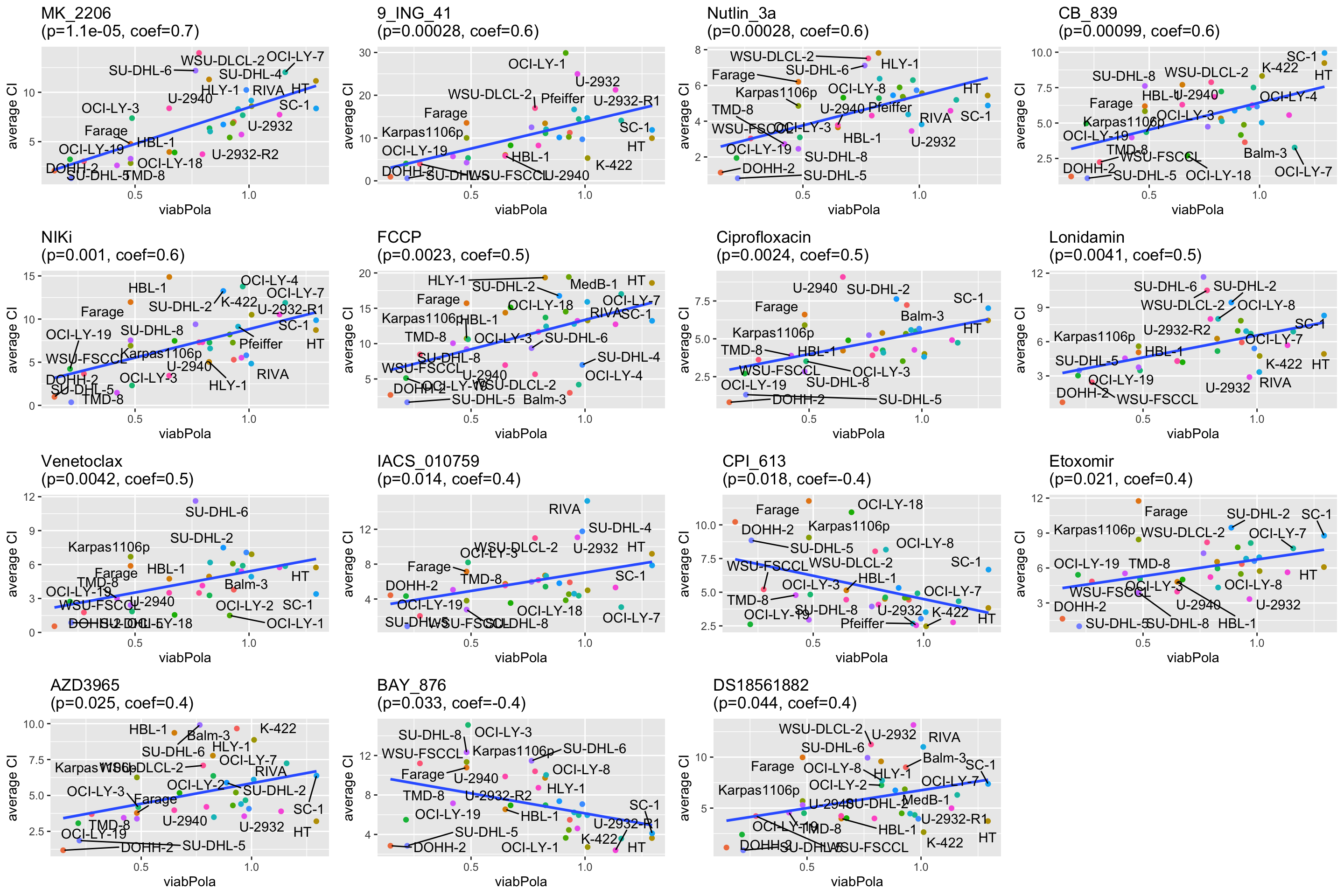
Test for synergistic effect related to genomics
Preprocess genomics
load("../data/SVs_filtered.RData")

mutTab <- svTab %>% filter(Name %in% ciTabBayes$Name) %>%
  group_by(Name, Gene) %>% summarise(n = length(Name)) %>%
  arrange(desc(n))
`summarise()` has grouped output by 'Name'. You can override using the
`.groups` argument.#Get mutations occured at least in three cell lines
geneCount <- group_by(mutTab, Gene) %>% summarise(n=length(Name)) %>%
filter(n>=3) %>% arrange(desc(n))
mutTab <- filter(mutTab, Gene %in% geneCount$Gene) %>%
mutate(status =1) %>% select(Name, Gene, status) %>%
pivot_wider(names_from = "Gene", values_from = "status") %>%
mutate_all(replace_na,0) %>%
pivot_longer(-Name, names_to = "Gene", values_to = "status")`mutate_all()` ignored the following grouping variables:
• Column `Name`
ℹ Use `mutate_at(df, vars(-group_cols()), myoperation)` to silence the message.T-test
testTab <- ciTabBayes %>% full_join(mutTab, by = "Name") %>%
  pivot_longer(c("syn","anta"), names_to = "effect", values_to = "CI") %>%
  filter(!is.na(Gene),!is.na(CI), effect =="syn")

resTab <- group_by(testTab, Drug_A, Gene, effect) %>% nest() %>%
  mutate(m = map(data, ~t.test(CI ~ status,., var.equal=TRUE))) %>%
  mutate(res = map(m, broom::tidy)) %>%
  unnest(res) %>%
  select(Drug_A, Gene, effect, estimate, p.value) %>%
  arrange(p.value) %>% ungroup() %>%
  mutate(p.adj = p.adjust(p.value, method = "BH"))

resTab.sig <- filter(resTab, p.adj <= 0.1)
hist(resTab$p.value)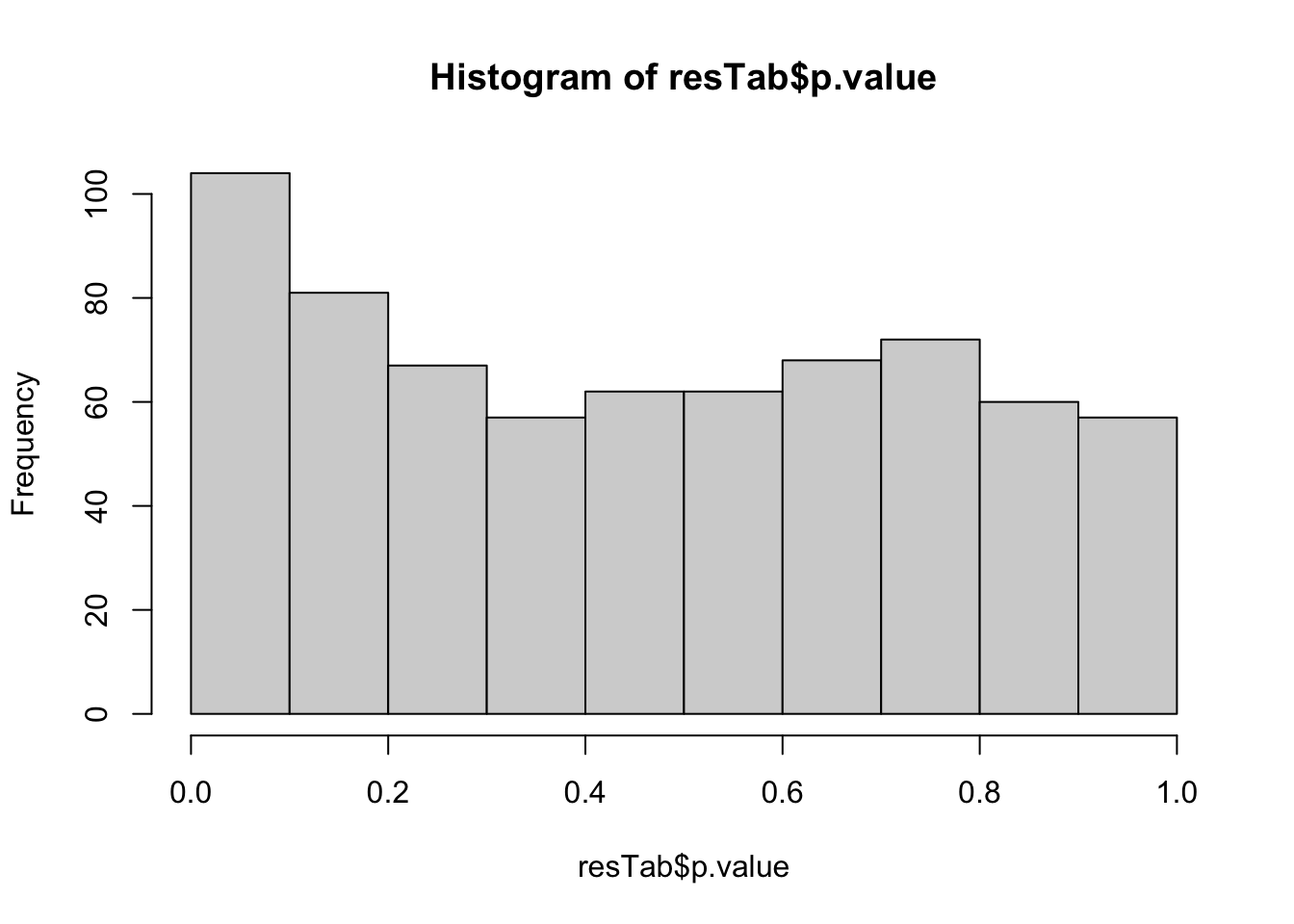
Boxplots for associations passed 10% FDR
pList <- lapply(seq(nrow(resTab.sig)), function(i) {
  rec <- resTab.sig[i,]
  plotTab <- filter(testTab, Drug_A == rec$Drug_A, Gene == rec$Gene, effect == rec$effect) %>%
    mutate(status = factor(status))
  ggplot(plotTab, aes(x=status, y=CI)) +
    geom_boxplot(aes(fill = status)) +
    geom_point() +
    ggtitle(sprintf("%s ~ %s (p=%s)",rec$Drug_A, rec$Gene, formatC(rec$p.value, digits = 2))) +
    xlab(rec$Gene) +
    theme_bw() +
    theme(legend.position = "none")
})

cowplot::plot_grid(plotlist = pList, ncol=4)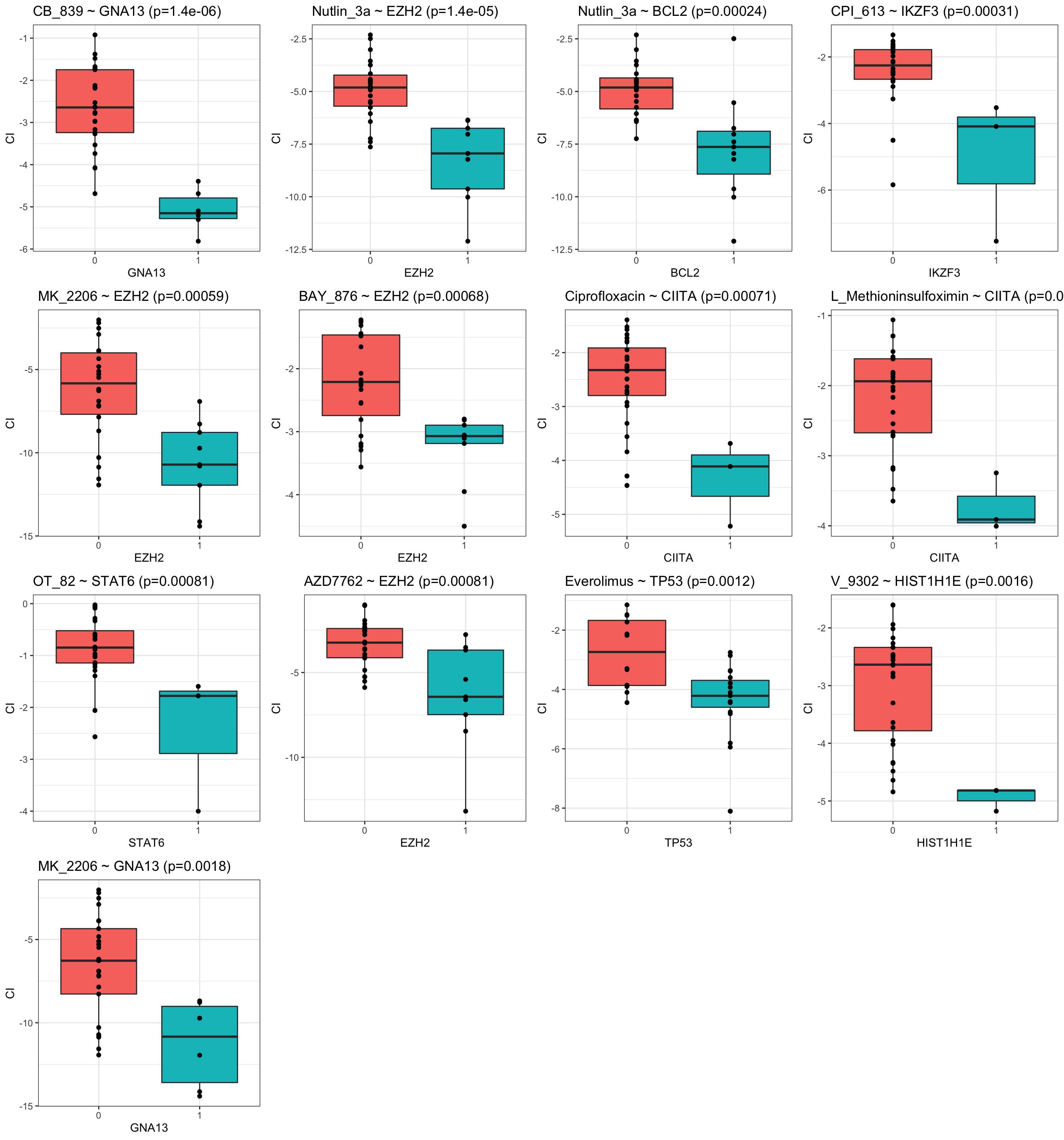
Heatmap
library(pheatmap)
ciTab <- testTab %>%
  filter(Gene %in% resTab.sig$Gene, Drug_A %in% resTab.sig$Drug_A)

ciMat <- distinct(ciTab, Name, Drug_A, CI) %>%
  pivot_wider(names_from = "Name", values_from = "CI") %>%
  column_to_rownames("Drug_A") %>% as.matrix()

colAnno <- ciTab %>% ungroup() %>% distinct(Name, Gene, status) %>%
  mutate(status = as.character(status)) %>%
  pivot_wider(names_from = "Gene", values_from = "status") %>%
  column_to_rownames("Name")
annoColor <- lapply(colnames(colAnno), function(x) {c("1"="black","0"="white")})
names(annoColor) <- colnames(colAnno)
pheatmap(ciMat, annotation_col = colAnno, annotation_colors = annoColor)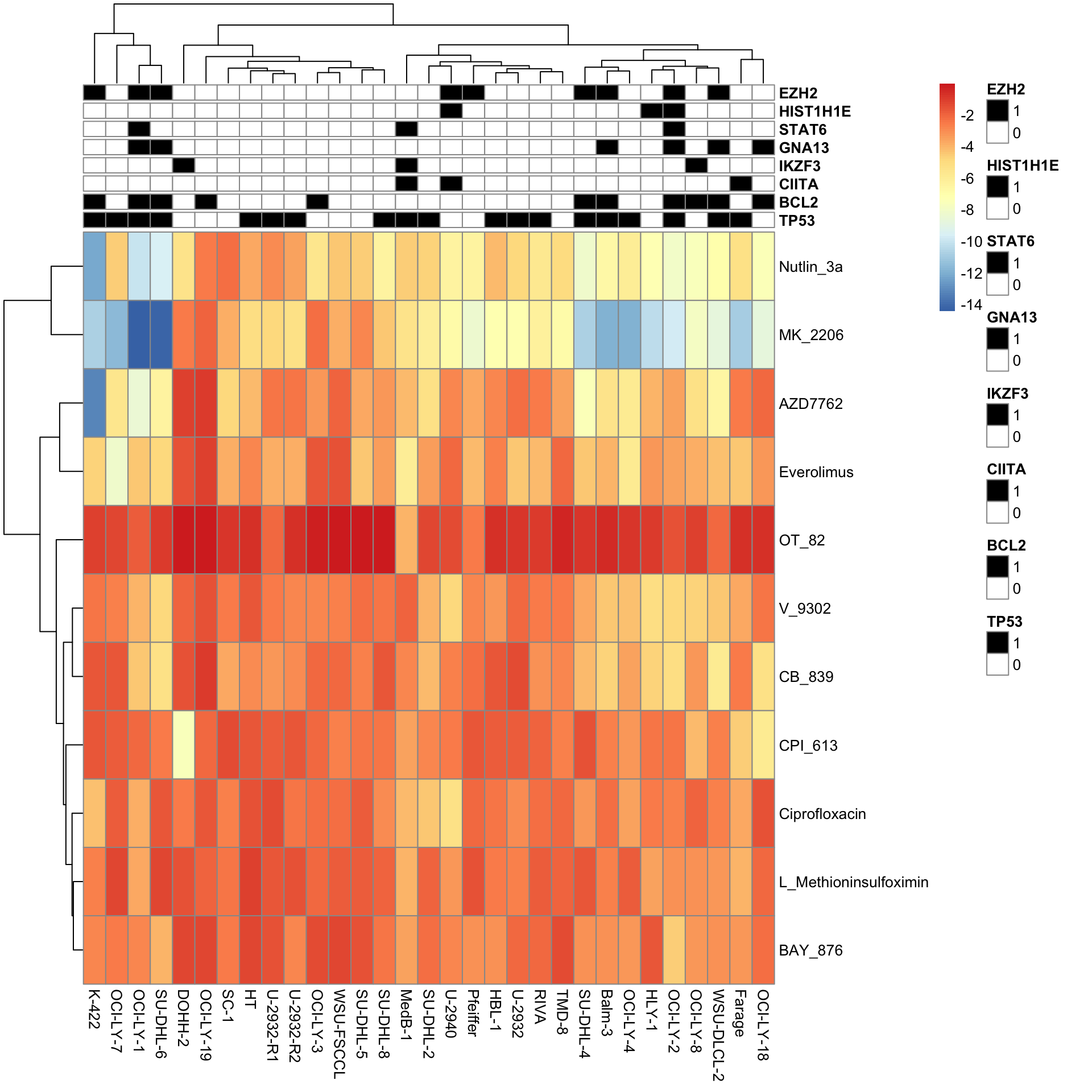
sessionInfo()R version 4.2.0 (2022-04-22)
Platform: x86_64-apple-darwin17.0 (64-bit)
Running under: macOS Big Sur/Monterey 10.16
Matrix products: default
BLAS: /Library/Frameworks/R.framework/Versions/4.2/Resources/lib/libRblas.0.dylib
LAPACK: /Library/Frameworks/R.framework/Versions/4.2/Resources/lib/libRlapack.dylib
locale:
[1] en_US.UTF-8/en_US.UTF-8/en_US.UTF-8/C/en_US.UTF-8/en_US.UTF-8
attached base packages:
[1] stats graphics grDevices utils datasets methods base
other attached packages:
[1] pheatmap_1.0.12 bayesynergy_2.4.1 forcats_0.5.1 stringr_1.4.0
[5] dplyr_1.0.9 purrr_0.3.4 readr_2.1.2 tidyr_1.2.0
[9] tibble_3.1.7 ggplot2_3.3.6 tidyverse_1.3.1
loaded via a namespace (and not attached):
[1] colorspace_2.0-3 ellipsis_0.3.2 ggridges_0.5.3
[4] rgdal_1.5-30 rprojroot_2.0.3 fs_1.5.2
[7] rstudioapi_0.13 farver_2.1.0 rstan_2.21.5
[10] ggrepel_0.9.1 fansi_1.0.3 mvtnorm_1.1-3
[13] lubridate_1.8.0 xml2_1.3.3 splines_4.2.0
[16] bridgesampling_1.1-2 codetools_0.2-18 doParallel_1.0.17
[19] knitr_1.39 jsonlite_1.8.0 workflowr_1.7.0
[22] Cairo_1.5-15 broom_0.8.0 dbplyr_2.1.1
[25] compiler_4.2.0 httr_1.4.3 backports_1.4.1
[28] assertthat_0.2.1 Matrix_1.4-1 fastmap_1.1.0
[31] lazyeval_0.2.2 cli_3.3.0 later_1.3.0
[34] htmltools_0.5.2 prettyunits_1.1.1 tools_4.2.0
[37] igraph_1.3.1 coda_0.19-4 gtable_0.3.0
[40] glue_1.6.2 inlmisc_0.5.5 Rcpp_1.0.8.3
[43] cellranger_1.1.0 jquerylib_0.1.4 raster_3.5-15
[46] vctrs_0.4.1 nlme_3.1-157 iterators_1.0.14
[49] xfun_0.31 ps_1.7.0 rvest_1.0.2
[52] lifecycle_1.0.1 terra_1.5-21 scales_1.2.0
[55] hms_1.1.1 doSNOW_1.0.20 promises_1.2.0.1
[58] Brobdingnag_1.2-7 parallel_4.2.0 inline_0.3.19
[61] RColorBrewer_1.1-3 yaml_2.3.5 gridExtra_2.3
[64] loo_2.5.1 StanHeaders_2.21.0-7 sass_0.4.1
[67] stringi_1.7.6 highr_0.9 foreach_1.5.2
[70] pkgbuild_1.3.1 rlang_1.0.2 pkgconfig_2.0.3
[73] matrixStats_0.62.0 evaluate_0.15 lattice_0.20-45
[76] htmlwidgets_1.5.4 labeling_0.4.2 cowplot_1.1.1
[79] tidyselect_1.1.2 processx_3.5.3 plyr_1.8.7
[82] magrittr_2.0.3 R6_2.5.1 snow_0.4-4
[85] generics_0.1.2 DBI_1.1.2 mgcv_1.8-40
[88] pillar_1.7.0 haven_2.5.0 withr_2.5.0
[91] sp_1.4-7 modelr_0.1.8 crayon_1.5.1
[94] utf8_1.2.2 plotly_4.10.0 tzdb_0.3.0
[97] rmarkdown_2.14 grid_4.2.0 readxl_1.4.0
[100] data.table_1.14.2 callr_3.7.0 git2r_0.30.1
[103] reprex_2.0.1 digest_0.6.29 httpuv_1.6.5
[106] RcppParallel_5.1.5 stats4_4.2.0 munsell_0.5.0
[109] viridisLite_0.4.0 bslib_0.3.1