Time series analysis on the treated group
Junyan Lu
17 May 2024
Last updated: 2024-05-17
Checks: 5 1
Knit directory:
SpinalCord_proteomics/analysis/
This reproducible R Markdown analysis was created with workflowr (version 1.7.0). The Checks tab describes the reproducibility checks that were applied when the results were created. The Past versions tab lists the development history.
Great job! The global environment was empty. Objects defined in the global environment can affect the analysis in your R Markdown file in unknown ways. For reproduciblity it’s best to always run the code in an empty environment.
The command set.seed(20221110) was run prior to running
the code in the R Markdown file. Setting a seed ensures that any results
that rely on randomness, e.g. subsampling or permutations, are
reproducible.
Great job! Recording the operating system, R version, and package versions is critical for reproducibility.
Nice! There were no cached chunks for this analysis, so you can be confident that you successfully produced the results during this run.
Great job! Using relative paths to the files within your workflowr project makes it easier to run your code on other machines.
Tracking code development and connecting the code version to the
results is critical for reproducibility. To start using Git, open the
Terminal and type git init in your project directory.
This project is not being versioned with Git. To obtain the full
reproducibility benefits of using workflowr, please see
?wflow_start.
What are the protein markers that in general change over time?
Subsetting
#subset for patients in the placebo group
protSub <- prepareProt(seProt_corr, filterCondi = list(Treatment = "1"), perNA =0.5, adjustPat = TRUE)
[1] "Number of proteins: 377, number of samples: 202"#subset for patients with all three time points
pat.complete <- colData(protSub) %>%
as_tibble() %>% group_by(PSN) %>%
summarise(n = length(Visit)) %>%
filter(n>=3)
protSub <- protSub[,protSub$PSN %in% pat.complete$PSN]
print("How many patients?")[1] "How many patients?"nrow(pat.complete)[1] 59print("How many proteins and samples")[1] "How many proteins and samples"dim(protSub)[1] 377 177Use spline fitting to identify proteins that change over time.
protMat <- assay(protSub)
designTab <- colData(protSub) %>%
data.frame()
designTab$X <- splines::ns(designTab$Visit, df=2)
design <- model.matrix(~0 + X + PSN, designTab)
resTab <- testDiff(protSub, design, c("X1","X2"), assayName = "imputed")Table of proteins passed raw P-value < 0.05
filter(resTab, pval <= 0.05) %>% mutate(across(where(is.numeric), formatC, digits=2)) %>%
select(name, symbol, pval, adj_pval, n_obs) %>%
DT::datatable()Visualize top hits using line plot
exprMat <- assays(protSub)[["imputed"]]
exprMat.patReg <- assays(protSub)[["patReg"]]
pList <- lapply(seq(20), function(i) {
rec <- resTab[i,]
plotTab <- tibble(expr = exprMat.patReg[rec$name,],
PSN = protSub$PSN,
Visit = protSub$Visit,
nodeGroup = protSub$nodeGroup)
ggplot(plotTab, aes(x=factor(Visit), y=expr, group = PSN, color = nodeGroup)) +
geom_line() +
geom_point() +
ggtitle(sprintf("%s (P=%s)",rec$symbol,formatC(rec$pval, digits = 2))) +
#scale_color_gradient(low="green",high="red") +
theme_bw() +
theme(plot.title = element_text(hjust = 0.5, face = "bold")) +
theme_full +
xlab("Visit") + ylab("Expression")
})
cowplot::plot_grid(plotlist = pList, ncol=4)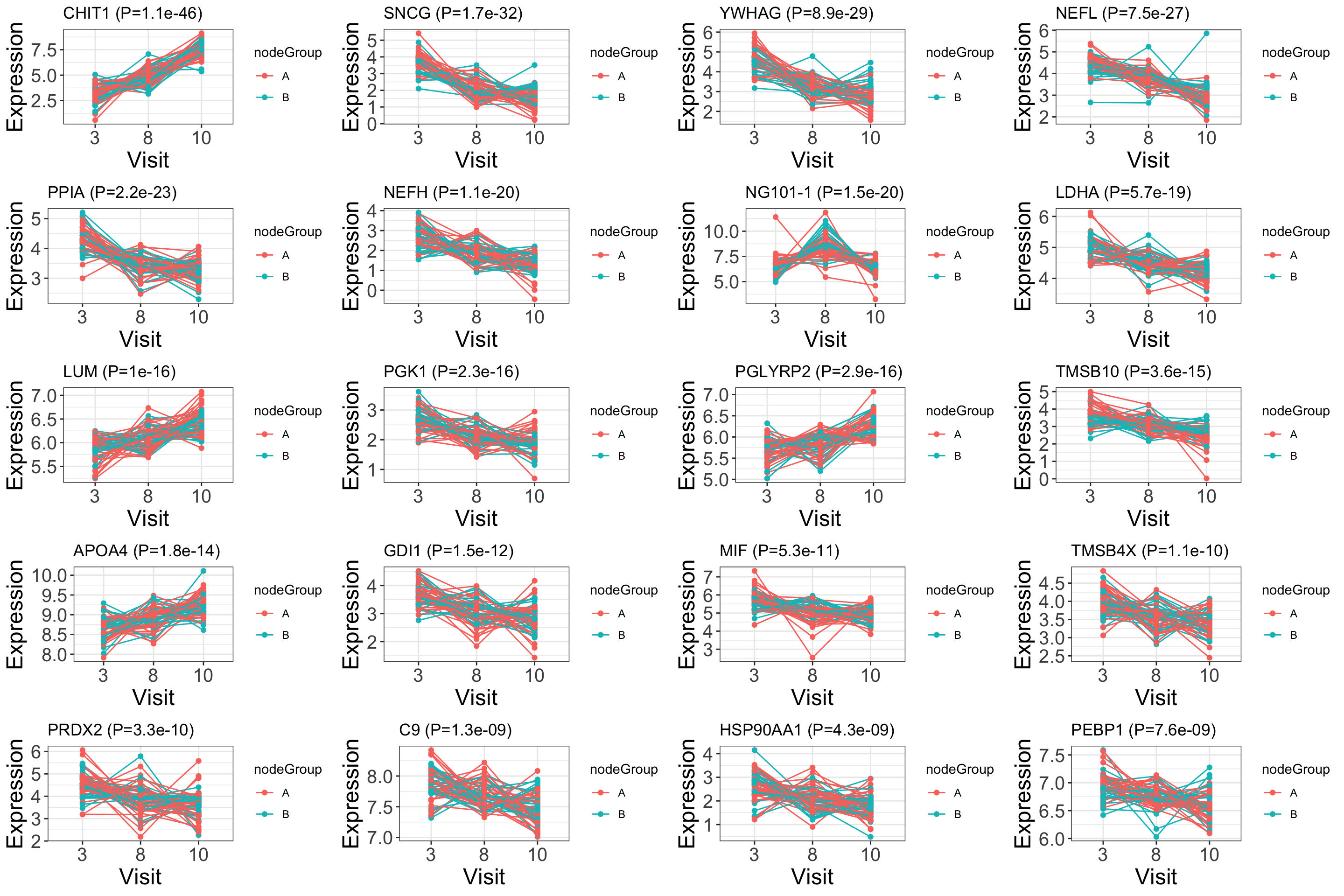
Visualization using heatmap
#need to adjust for patient specific effect first
plotMat <- exprMat.patReg[filter(resTab, adj_pval < 0.1)$name,]
annoCol <- tibble(row = colnames(plotMat),
Visit = protSub[,row]$Visit) %>%
arrange(Visit) %>%
mutate(Visit = paste0("V",Visit)) %>%
column_to_rownames("row") %>% data.frame()
plotMat <- plotMat[,rownames(annoCol)]
pheatmap::pheatmap(plotMat, scale = "row", cluster_rows = TRUE, cluster_cols = FALSE,
color=colorRampPalette(c("navy", "white", "red"))(50),
labels_row = rowData(protSub[rownames(plotMat),])$symbol,
annotation_col = annoCol, clustering_method = "ward.D2")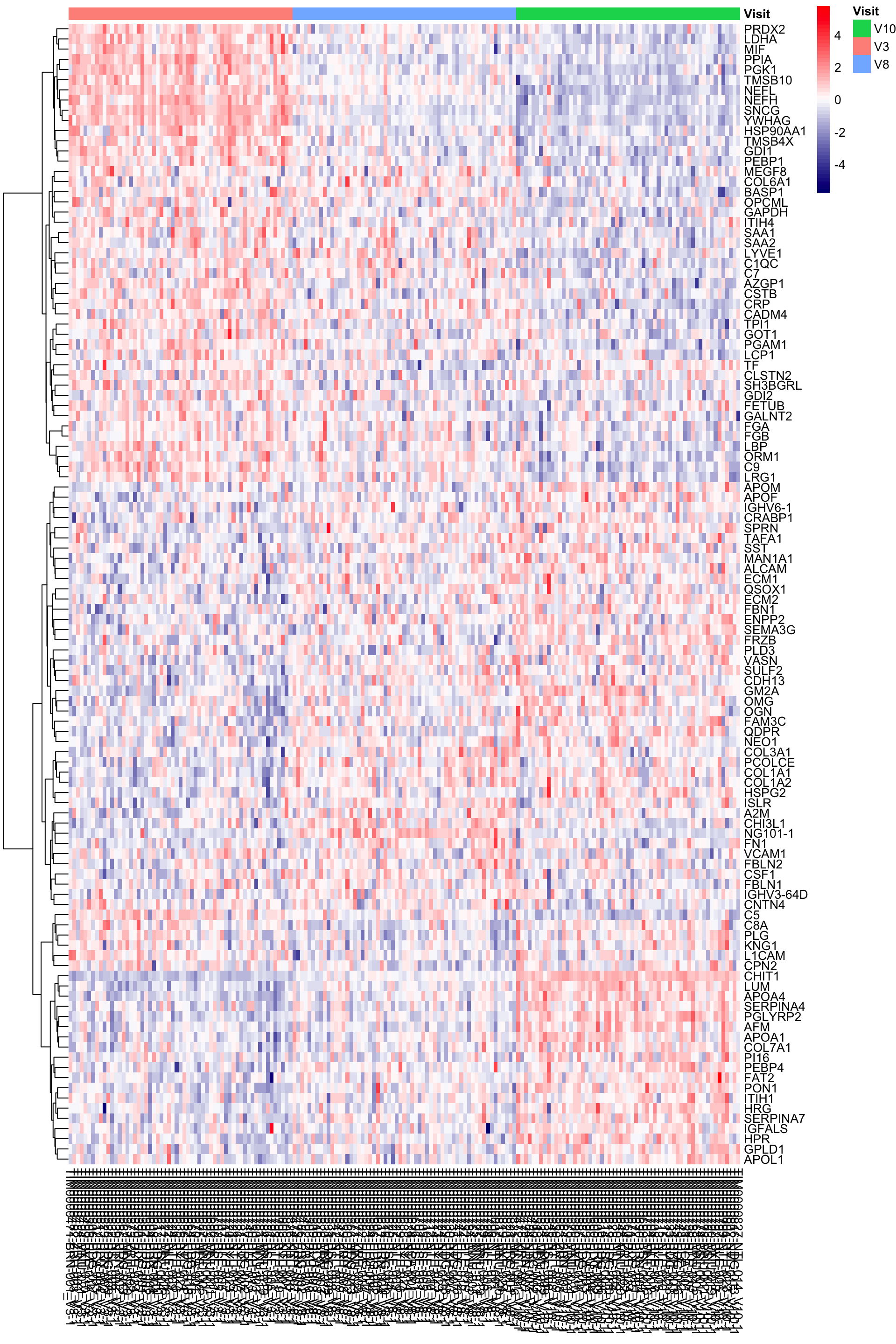
What are the protein markers that change over time and show different trend in the better recovered and worse recovered patients?
Use all three time points
Prepare data
#subset for patients in the placebo group
protSub <- prepareProt(seProt_corr, filterCondi = list(Treatment = "1"), perNA = 0.5, adjustPat = TRUE)[1] "Number of proteins: 377, number of samples: 202"#seProt_corr[,seProt_corr$Treatment %in% 0 & !is.na(seProt_corr$delta_UEMS)]
protSub$group_UEMS <- ifelse(protSub$delta_UEMS >= quantile(protSub$delta_UEMS,0.75, na.rm=TRUE), "high",
ifelse(protSub$delta_UEMS <= quantile(protSub$delta_UEMS,0.25, na.rm=TRUE), "low", NA))
protSub <- protSub[,!is.na(protSub$group_UEMS)]
#subset for patients with all three time points
pat.complete <- colData(protSub) %>%
    as_tibble() %>% group_by(PSN) %>%
    summarise(n = length(Visit)) %>%
    filter(n>=3)
protSub <- protSub[,protSub$PSN %in% pat.complete$PSN]

print("How many patients?")
[1] "How many patients?"nrow(pat.complete)[1] 27print("How many proteins and samples")[1] "How many proteins and samples"dim(protSub)[1] 377 81The high and low delta_UEMS are defined by 75% quantile. The high_UEMS group is the group with better recovery.
Use spline fitting to identify proteins that change overtime.
designTab <- colData(protSub) %>%
data.frame()
designTab$X <- splines::ns(designTab$Visit, df=2)
design <- model.matrix(~ group_UEMS + X + X:group_UEMS, designTab)
resTab <- testDiff(protSub, design, coef = c("group_UEMSlow:X1","group_UEMSlow:X2"), blockID = "PSN", assayName = "imputed")
hist(resTab$pval)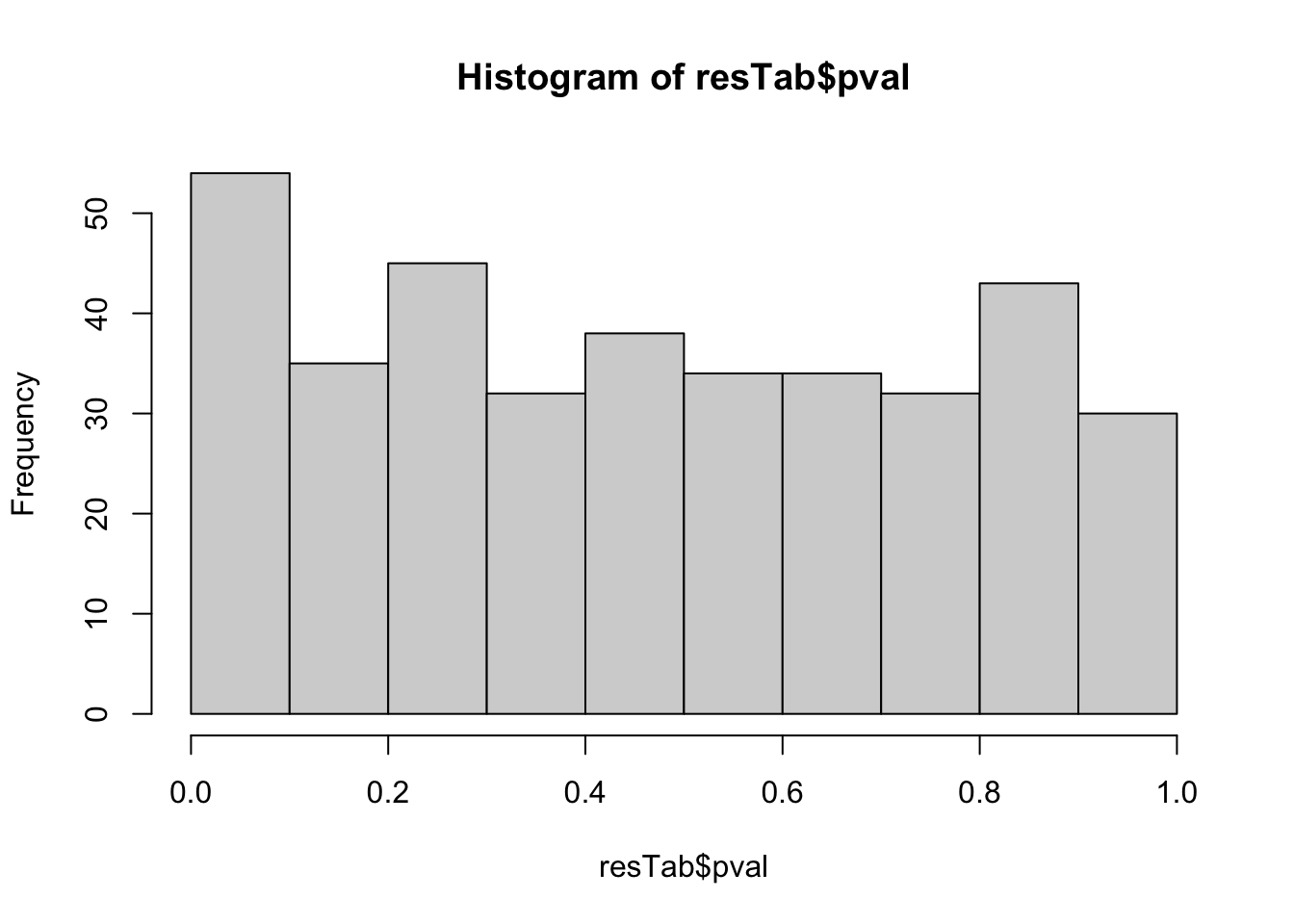
Table of proteins passed raw P-value < 0.05
filter(resTab, pval <= 0.05) %>% mutate(across(where(is.numeric), formatC, digits=2)) %>%
  select(name, symbol, pval, adj_pval, n_obs) %>%
  DT::datatable()
Visualize top hits using line plot
plotDiffTrend(protSub, "group_UEMS")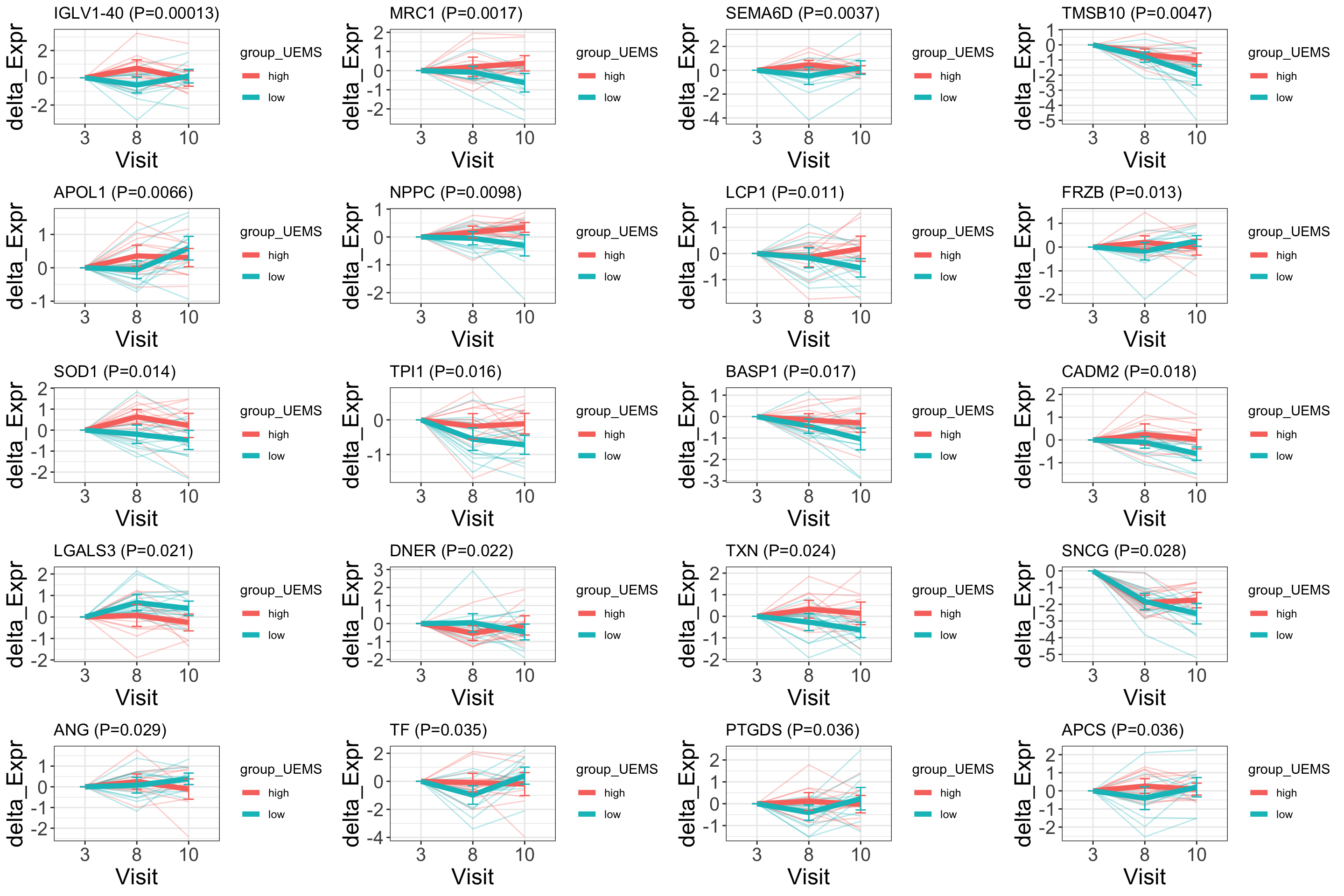 The y-axis shows the expression change to baseline (Visit 3) to
better visualize the change
The y-axis shows the expression change to baseline (Visit 3) to
better visualize the change
Only look at the first two time points
Subsetting
#subset for patients in the placebo group
protSub <- prepareProt(seProt_corr, filterCondi = list(Treatment = "1", Visit =c(3,8)), perNA = 0.5, adjustPat = TRUE)[1] "Number of proteins: 378, number of samples: 140"#seProt_corr[,seProt_corr$Treatment %in% 0 & !is.na(seProt_corr$delta_UEMS)]
protSub$group_UEMS <- ifelse(protSub$delta_UEMS >= quantile(protSub$delta_UEMS,0.75, na.rm=TRUE), "high",
ifelse(protSub$delta_UEMS <= quantile(protSub$delta_UEMS,0.25, na.rm=TRUE), "low", NA))
protSub <- protSub[,!is.na(protSub$group_UEMS)]
#subset for patients with all three time points
pat.complete <- colData(protSub) %>%
as_tibble() %>% group_by(PSN) %>%
summarise(n = length(Visit)) %>%
filter(n>=2)
protSub <- protSub[,protSub$PSN %in% pat.complete$PSN]
print("How many patients?")[1] "How many patients?"nrow(pat.complete)[1] 32print("How many proteins and samples")[1] "How many proteins and samples"dim(protSub)[1] 378 64Use spline fitting to identify proteins that change overtime.
design <- model.matrix(~group_UEMS + Visit + Visit:group_UEMS, colData(protSub))
resTab <- testDiff(protSub, design, coef = "group_UEMSlow:Visit", assayName = "imputed", method = "limma", blockID = "PSN")
hist(resTab$pval)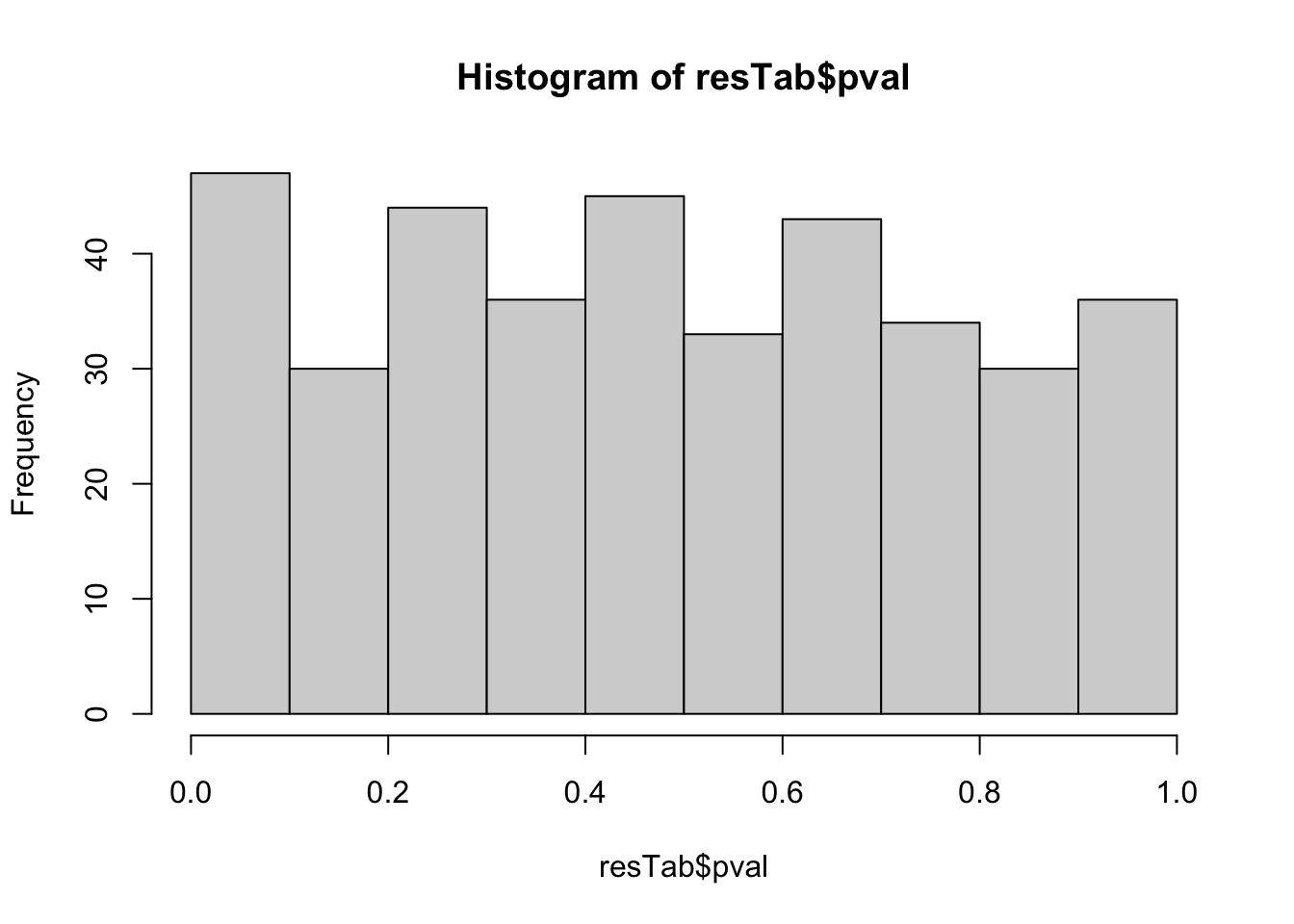
Table of proteins passed raw P-value < 0.05
filter(resTab, pval <= 0.05) %>% mutate(across(where(is.numeric), formatC, digits=2)) %>%
select(name, symbol, pval, adj_pval, n_obs) %>%
DT::datatable()Visualize top hits using line plot
plotDiffTrend(protSub, "group_UEMS")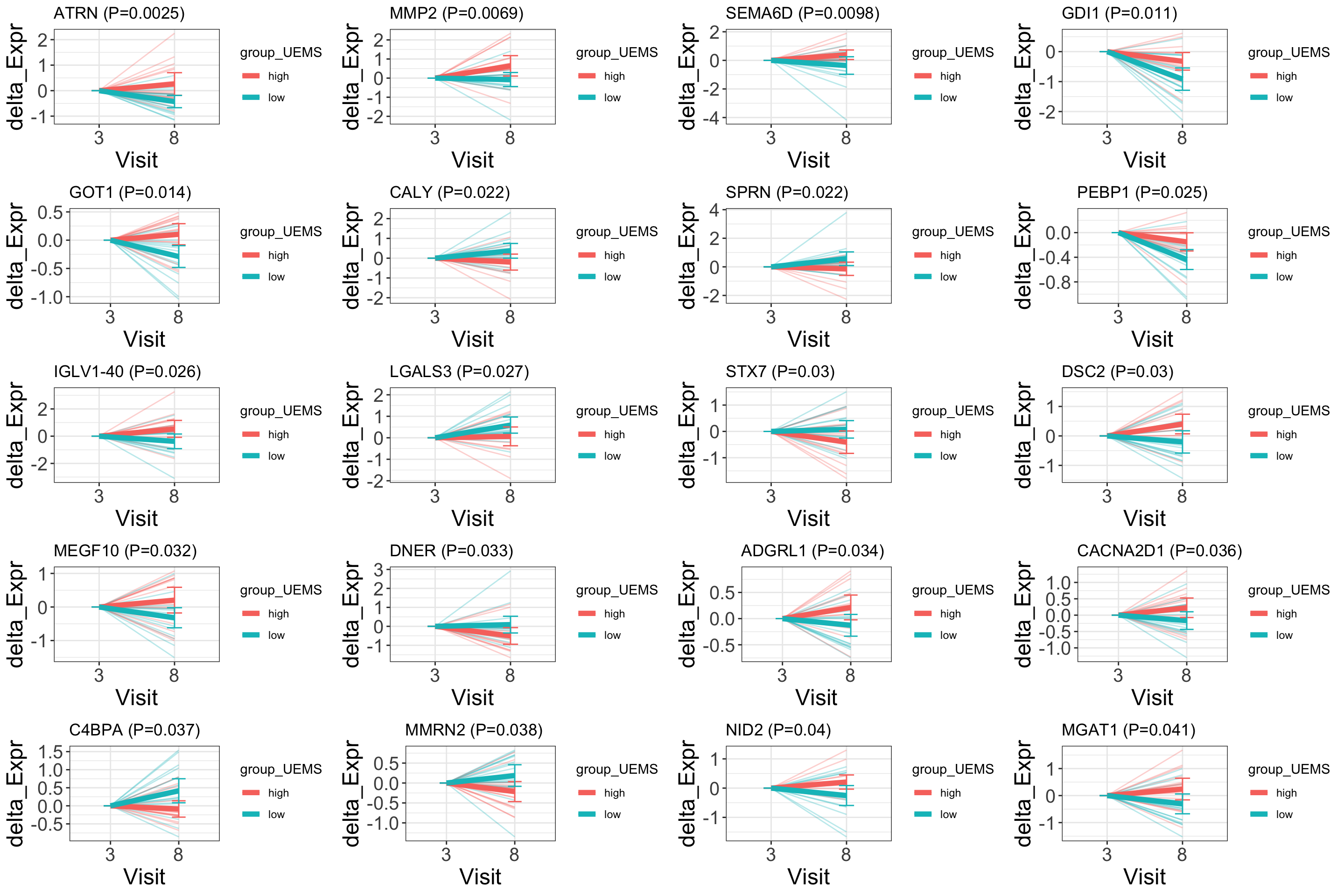
What are the protein markers that change over time and show different trend in the two random node groups, nodeGroup?
Use all three time points
Subsetting
#subset for patients in the placebo group
protSub <- prepareProt(seProt_corr, filterCondi = list(Treatment = "1"), perNA = 0.5, adjustPat = TRUE)
[1] "Number of proteins: 377, number of samples: 202"#subset for patients with all three time points
pat.complete <- colData(protSub) %>%
as_tibble() %>% group_by(PSN) %>%
summarise(n = length(Visit)) %>%
filter(n>=3)
protSub <- protSub[,protSub$PSN %in% pat.complete$PSN]
print("How many patients?")[1] "How many patients?"nrow(pat.complete)[1] 59print("How many proteins and samples")[1] "How many proteins and samples"dim(protSub)[1] 377 177Use spline fitting to identify proteins that change overtime.
designTab <- colData(protSub) %>%
data.frame()
designTab$X <- splines::ns(designTab$Visit, df=2)
design <- model.matrix(~ nodeGroup + X + X:nodeGroup, designTab)
resTab <- testDiff(protSub, design, coef = c("nodeGroupB:X1","nodeGroupB:X2"), blockID = "PSN", assayName = "imputed")
hist(resTab$pval)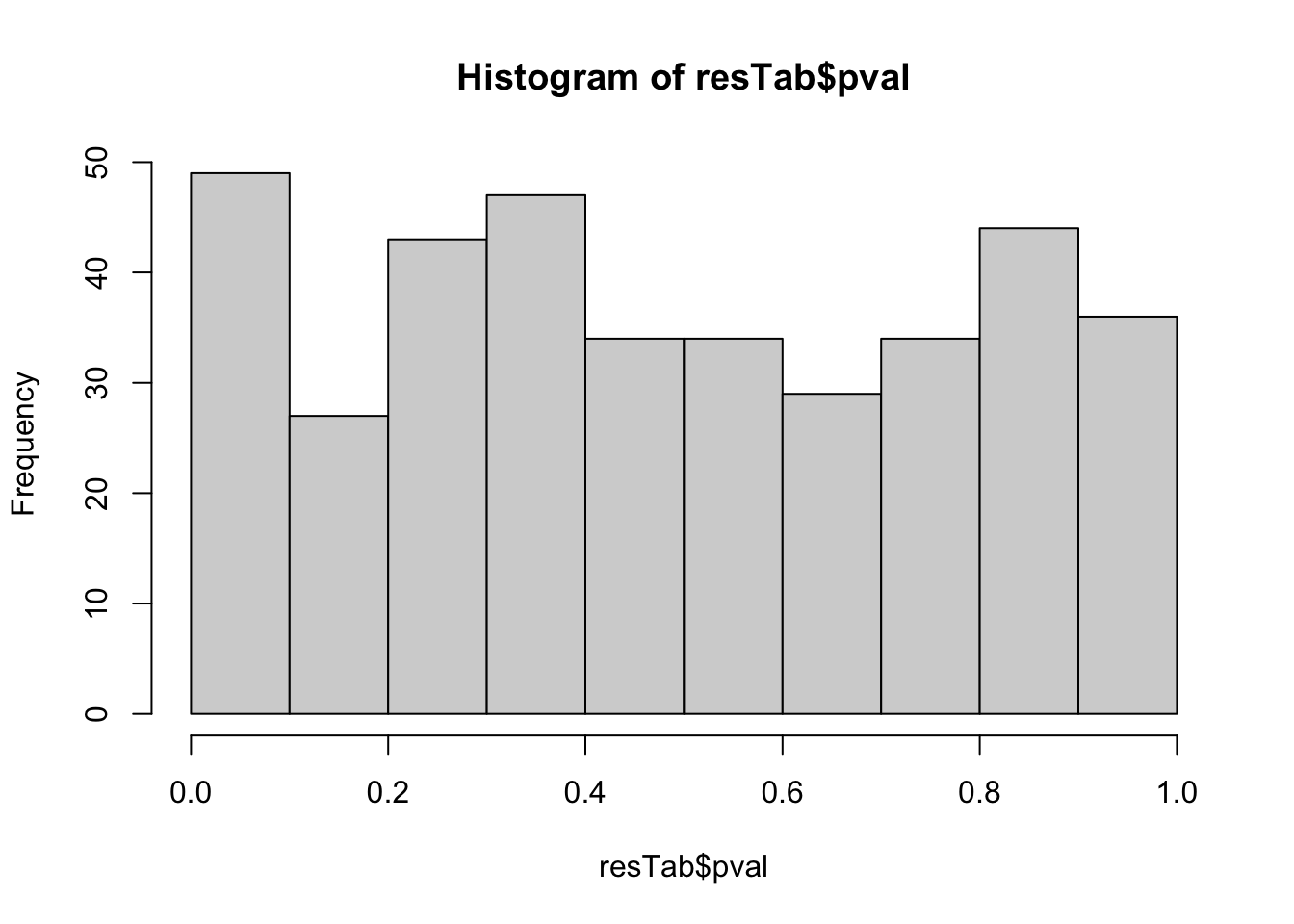
Table of proteins passed raw P-value < 0.05
filter(resTab, pval <= 0.05) %>% mutate(across(where(is.numeric), formatC, digits=2)) %>%
  select(name, symbol, pval, adj_pval, n_obs) %>%
  DT::datatable()
Visualize top hits using line plot
plotDiffTrend(protSub, "nodeGroup")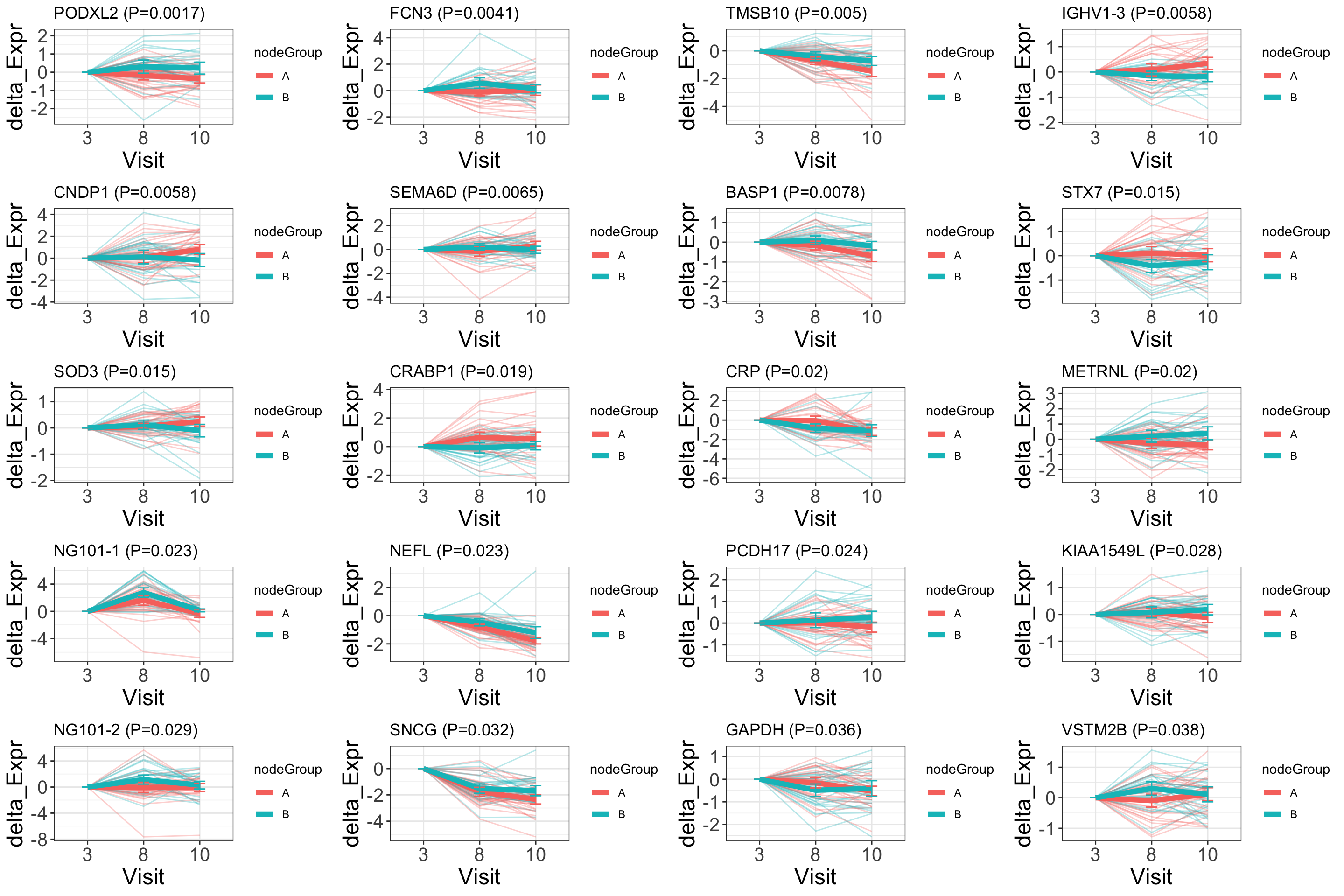
Only look at the first two time points
Subsetting
#subset for patients in the placebo group
protSub <- prepareProt(seProt, filterCondi = list(Treatment = "1", Visit =c(3,8)), perNA = 0.8, adjustPat = TRUE)[1] "Number of proteins: 428, number of samples: 140"#subset for patients with all three time points
pat.complete <- colData(protSub) %>%
as_tibble() %>% group_by(PSN) %>%
summarise(n = length(Visit)) %>%
filter(n>=2)
protSub <- protSub[,protSub$PSN %in% pat.complete$PSN]
print("How many patients?")[1] "How many patients?"nrow(pat.complete)[1] 66print("How many proteins and samples")[1] "How many proteins and samples"dim(protSub)[1] 428 132Use spline fitting to identify proteins that change overtime.
design <- model.matrix(~nodeGroup + Visit + Visit:nodeGroup, colData(protSub))
resTab <- testDiff(protSub, design, coef = "nodeGroupB:Visit", assayName = "imputed", method = "limma", blockID = "PSN")
hist(resTab$pval)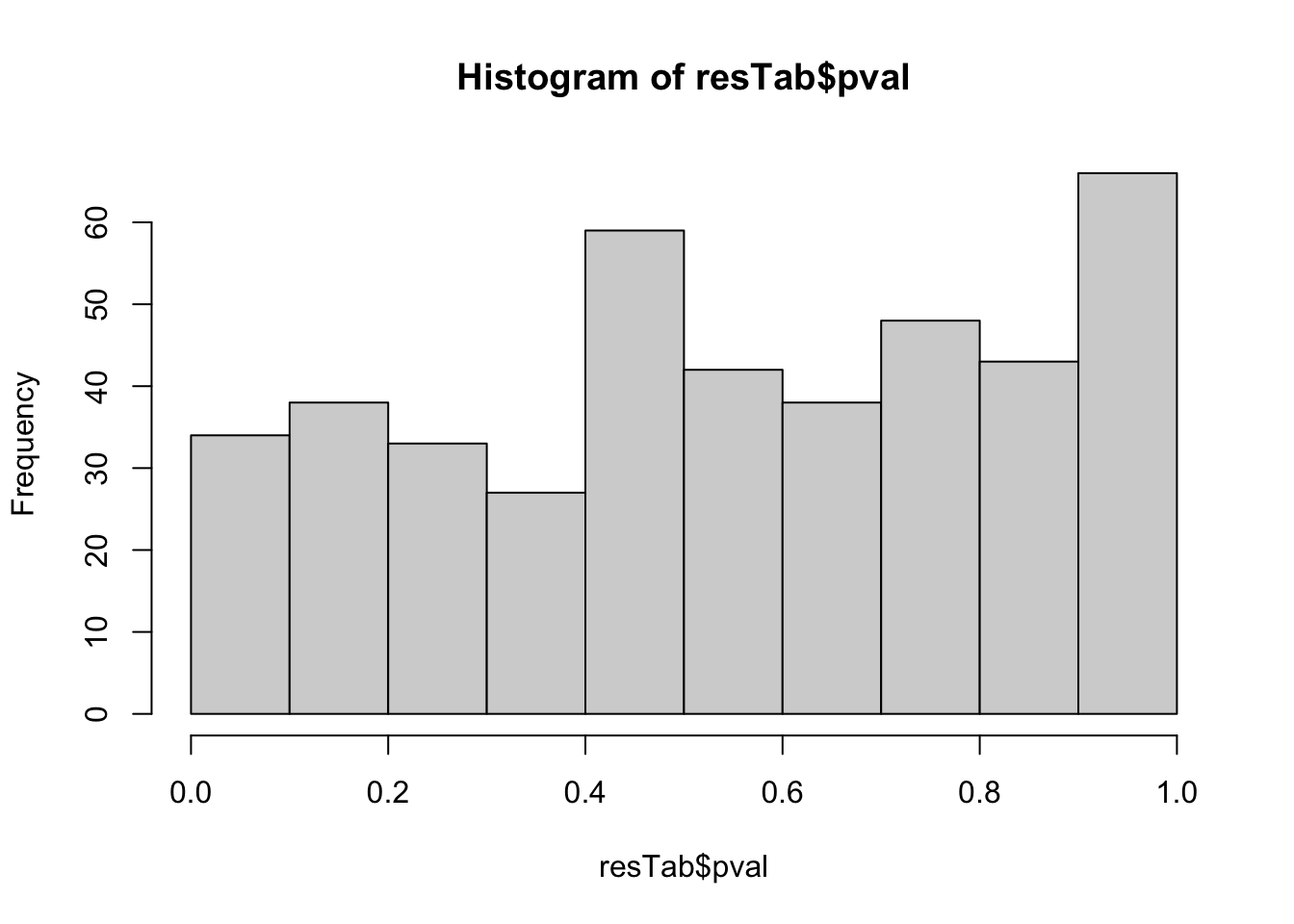
Table of proteins passed raw P-value < 0.05
filter(resTab, pval <= 0.05) %>% mutate(across(where(is.numeric), formatC, digits=2)) %>%
  select(name, symbol, pval, adj_pval, n_obs) %>%
  DT::datatable()
Visualize top hits using line plot
plotDiffTrend(protSub, "nodeGroup")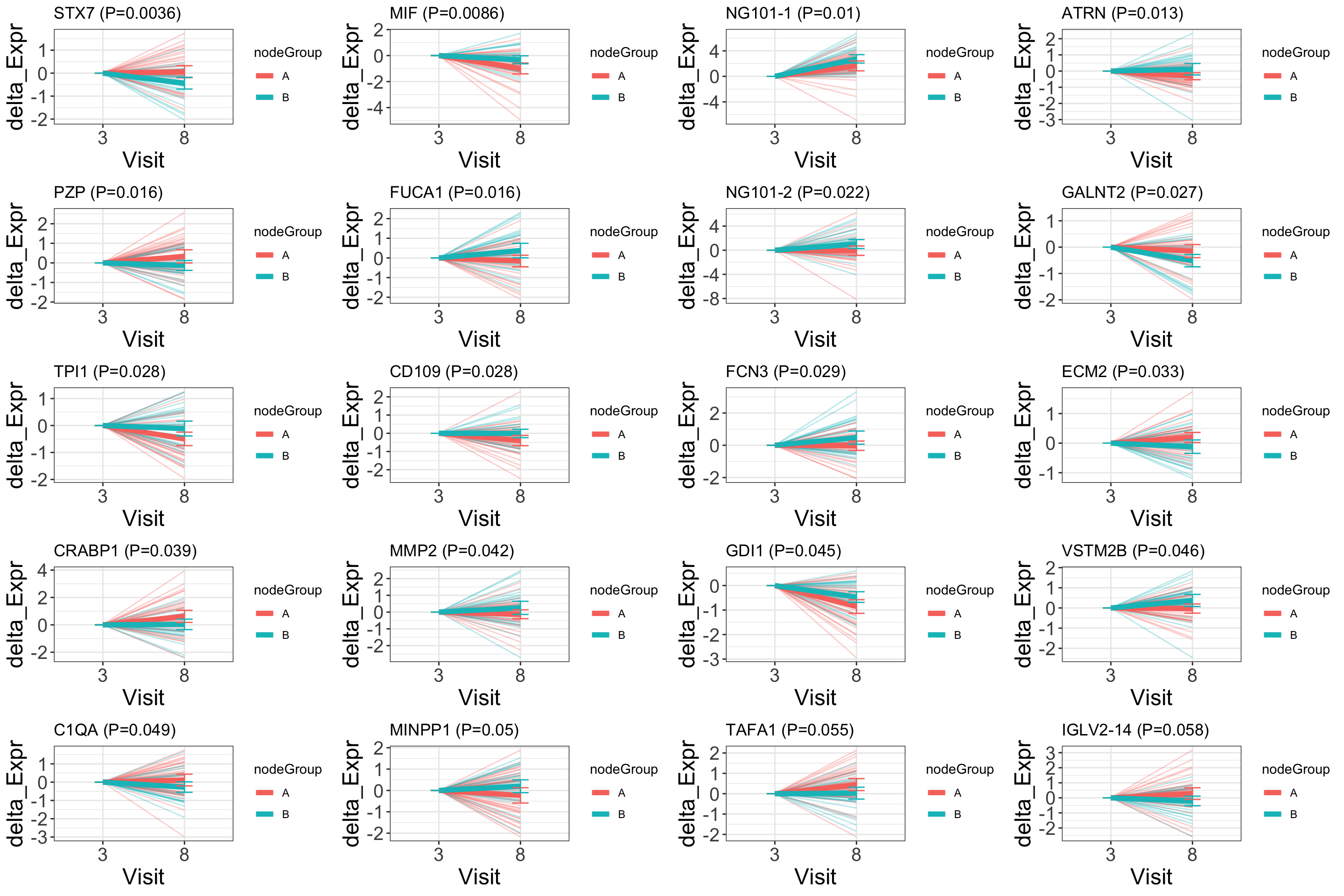
sessionInfo()R version 4.2.0 (2022-04-22)
Platform: x86_64-apple-darwin17.0 (64-bit)
Running under: macOS Big Sur/Monterey 10.16
Matrix products: default
BLAS: /Library/Frameworks/R.framework/Versions/4.2/Resources/lib/libRblas.0.dylib
LAPACK: /Library/Frameworks/R.framework/Versions/4.2/Resources/lib/libRlapack.dylib
locale:
[1] en_US.UTF-8/en_US.UTF-8/en_US.UTF-8/C/en_US.UTF-8/en_US.UTF-8
attached base packages:
[1] stats4 stats graphics grDevices utils datasets methods
[8] base
other attached packages:
[1] forcats_0.5.1 stringr_1.4.1
[3] dplyr_1.1.4.9000 purrr_0.3.4
[5] readr_2.1.2 tidyr_1.2.0
[7] tibble_3.2.1 ggplot2_3.4.1
[9] tidyverse_1.3.2 limma_3.52.2
[11] proDA_1.10.0 SummarizedExperiment_1.26.1
[13] Biobase_2.56.0 GenomicRanges_1.48.0
[15] GenomeInfoDb_1.32.2 IRanges_2.30.0
[17] S4Vectors_0.34.0 BiocGenerics_0.42.0
[19] MatrixGenerics_1.8.1 matrixStats_0.62.0
loaded via a namespace (and not attached):
[1] bitops_1.0-7 fs_1.5.2 lubridate_1.8.0
[4] RColorBrewer_1.1-3 httr_1.4.3 rprojroot_2.0.3
[7] tools_4.2.0 backports_1.4.1 bslib_0.4.1
[10] DT_0.23 utf8_1.2.4 R6_2.5.1
[13] DBI_1.1.3 colorspace_2.0-3 withr_3.0.0
[16] tidyselect_1.2.1 compiler_4.2.0 git2r_0.30.1
[19] rvest_1.0.2 cli_3.6.2 xml2_1.3.3
[22] DelayedArray_0.22.0 labeling_0.4.2 sass_0.4.2
[25] scales_1.2.0 digest_0.6.30 rmarkdown_2.14
[28] XVector_0.36.0 pkgconfig_2.0.3 htmltools_0.5.4
[31] highr_0.9 dbplyr_2.2.1 fastmap_1.1.0
[34] htmlwidgets_1.5.4 rlang_1.1.3 readxl_1.4.0
[37] rstudioapi_0.13 farver_2.1.1 jquerylib_0.1.4
[40] generics_0.1.3 jsonlite_1.8.3 crosstalk_1.2.0
[43] googlesheets4_1.0.0 RCurl_1.98-1.7 magrittr_2.0.3
[46] GenomeInfoDbData_1.2.8 Matrix_1.5-4 Rcpp_1.0.9
[49] munsell_0.5.0 fansi_1.0.6 lifecycle_1.0.4
[52] stringi_1.7.8 yaml_2.3.5 zlibbioc_1.42.0
[55] grid_4.2.0 promises_1.2.0.1 crayon_1.5.2
[58] lattice_0.20-45 cowplot_1.1.1 splines_4.2.0
[61] haven_2.5.0 hms_1.1.1 knitr_1.39
[64] pillar_1.9.0 reprex_2.0.1 glue_1.7.0
[67] evaluate_0.15 BiocManager_1.30.18 modelr_0.1.8
[70] vctrs_0.6.5 tzdb_0.3.0 httpuv_1.6.6
[73] cellranger_1.1.0 gtable_0.3.0 assertthat_0.2.1
[76] cachem_1.0.6 xfun_0.31 broom_1.0.0
[79] later_1.3.0 googledrive_2.0.0 gargle_1.2.0
[82] pheatmap_1.0.12 workflowr_1.7.0 statmod_1.4.36
[85] ellipsis_0.3.2 BiocStyle_2.24.0